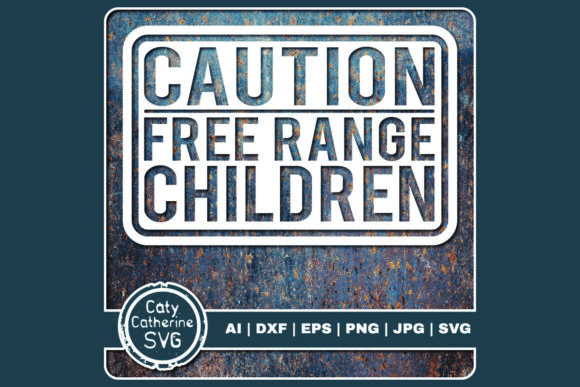
Reviewing the CAUTION Free Range Children Design
As a designer who spends half my life staring at digitized paths and the other half pulling thread jams out of a bobbin case, I have learned to look past the glossy preview images. When I first encountered the CAUTION Free Range Children design, I did not just see a cute graphic. I saw a potential headache or a bestseller, depending entirely on how it was executed. This is not just another SVG cut file; it is a statement piece that requires careful handling to translate well from screen to fabric.
The design, created by Caty Catherine, arrives in a comprehensive suite of formats including SVG, Transparent PNG, EPS, DXF, JPG, and AI. For those of us working strictly in the embroidery realm, the availability of vector-based files like EPS and AI is a significant advantage. It means we are not stuck with a pre-digitized file that might have poor stitch logic. Instead, we have the raw graphics to create a custom machine embroidery design that fits our specific hoop and fabric constraints. This flexibility is crucial for professional results.
The Visual Personality and First Impressions
The mood of this design is playful yet assertive. It taps into the modern parenting trend of "free-range" kids, which appeals to a specific demographic of buyers who value independence and humor. Visually, the layout is bold. The typography needs to be legible from a distance, which is critical for any sign-style graphic. When I imagine this as an embroidered patch or a front-chest logo on a sweatshirt, the contrast between the warning-sign aesthetic and the softness of the textile creates an interesting juxtaposition.
However, the devil is in the details. A design labeled as Graphics within the Crafts category often implies clean lines, but embroidery adds texture. Thick satin stitches can make small letters bulge, while dense fill stitches can cause puckering. My immediate thought was to simplify the lettering for smaller applications. If you are planning to use this on a baby onesie, the original scale might be too aggressive. You would need to resize and potentially reduce the stitch density to keep the garment comfortable and durable.
Real-World Application: The Tote Bag Test
Let’s walk through a real scenario. I recently needed a quick, high-impact product for a local craft fair. I chose a heavy canvas tote bag as the base for the CAUTION Free Range Children motif. Canvas is forgiving; it handles higher stitch counts without warping. I used the SVG file to trace the outline in my digitizing software, opting for a thick running stitch border and a satin stitch fill for the text.
The result was striking. The bold black thread against the natural beige canvas popped beautifully. Customers immediately smiled and pointed it out. It worked as a conversation starter, which is exactly what you want for a small shop product. However, had I chosen a thinner cotton tote, the backing of the stitches might have shown through, ruining the clean look. This highlights the importance of matching the design complexity to the fabric texture and weight.
Where Caution Is Actually Needed
While the design is versatile, it is not universal. There are specific scenarios where I would advise against using this exact layout without significant modification. First, avoid using it on highly stretchy fabrics like jersey knits unless you have a very stable stabilizer and experience with stretch materials. The rigid nature of the text and shapes can restrict the fabric's movement, leading to discomfort for the wearer.
Second, be wary of curved surfaces like caps. The straight lines of the "CAUTION" text can distort when stitched over the curve of a baseball cap. You would need to apply push-pull compensation in your digitizing software to ensure the letters remain straight after stitching. Additionally, if you are working with a small hoop size, such as a 4x4 inch hoop, you may need to crop the design or stack the elements vertically rather than horizontally to maintain legibility. Tiny lettering gets lost in the pile of the thread, so always prioritize clarity over fitting every element in.
Enhancing Product Value and Brand Consistency
For Etsy sellers and creative entrepreneurs, the perceived value of a personalized gift often hinges on execution quality. A sloppy stitch-out devalues the item, while a crisp, clean application increases trust. The CAUTION Free Range Children design, when done right, signals professionalism. It shows that you understand how to balance humor with technical precision.
This design also works well for brand consistency if you specialize in family-oriented or humorous home goods. Imagine a set of kitchen towels or aprons featuring this motif. It creates a cohesive collection that buyers can mix and match. For digital product sellers, offering this as part of a bundle with other safety-sign-themed graphics could increase average order value. Just remember to check the licensing terms provided by Caty Catherine before selling finished items or digital derivatives.
Practical Designer Notes for Success
Before you commit to a full production run, follow these steps to ensure quality:
- Test on scrap fabric first: Never stitch directly on your final product. Use the same type of fabric and stabilizer to check for puckering or thread breaks.
- Check thread color contrast: This design relies on readability. Ensure your thread colors stand out against the background fabric. Dark threads on dark fabrics will fail.
- Review stitch density: If the design feels stiff after stitching, reduce the density in your software. Less is often more in embroidery.
- Confirm hoop size: Measure the design dimensions against your machine’s maximum hoop area. Do not assume it will fit without checking.
- Inspect small details: Zoom in on the digitized view. Look for overlapping stitches or unnecessary jumps that could cause snags.
- Test in black and white mockups: This helps you see the shape and balance of the design without the distraction of color.
- Use proper stabilizer: For woven fabrics, a cut-away stabilizer provides long-term stability. For knits, consider a tear-away with a topping if the fabric has a nap.
In conclusion, the CAUTION Free Range Children design is a strong candidate for various commercial embroidery projects, provided you approach it with a designer’s eye. It is not just a file to be loaded and ignored. It requires thoughtful adaptation to the medium. Whether you are creating a holiday embroidery gift for a new parent or stocking your boutique with witty custom apparel, this design offers a solid foundation. Just respect the limitations of the thread and fabric, and you will create a finished product that customers love to wear and display.